

Concrete vs Bitumen Roads: Which Is Better for Indian Cities and Why?
Introduction
Road infrastructure plays a critical role in shaping the growth, efficiency, and safety of Indian cities.
With rising traffic volumes, expanding urban limits, and increasing freight movement, the choice of road type directly impacts long-term maintenance costs, public convenience, and economic productivity.
Selecting the right road technology is no longer just a construction decision; it has become a strategic urban planning choice.
Across India, authorities such as PMC, Zilla Parishads (ZP), PWD, and Smart City bodies are rapidly increasing investments in road development and upgradation.
With this increased spending comes greater focus on durability, lifecycle cost, faster execution, and reduced disruption to daily traffic.
This growing demand has also intensified the debate between concrete (cement) roads and bitumen (asphalt) roads, which one truly delivers better value for Indian cities?
Table of Contents
What Are Bitumen Roads?
Bitumen roads, also known as asphalt roads, are the most commonly used road type across India due to their relatively low initial construction cost and faster execution time.
These roads use bitumen as a binding material to hold aggregates together, creating a flexible pavement structure that can absorb minor surface movements.
Basic Construction Process
The construction of a bitumen road starts with proper subgrade preparation, followed by laying a strong base using graded materials.
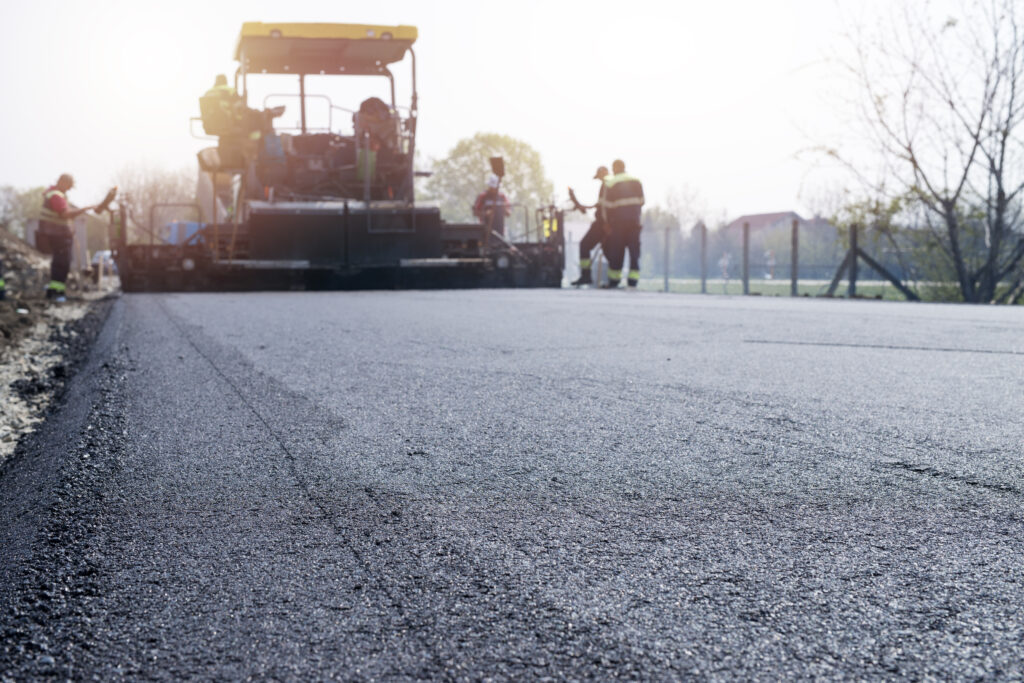
Once the base layers are compacted to the required density, hot bituminous mixes are laid using pavers and compacted with rollers.
The surface becomes traffic-ready within a short time after cooling, which makes bitumen roads ideal for projects that require quick reopening to traffic.
Typical Layers in a Bitumen Road
A standard bitumen road is built in multiple layers, each serving a specific structural purpose:
- GSB (Granular Sub-Base): The lowest layer that provides drainage and load distribution.
- WMM (Wet Mix Macadam): A strong granular base that carries traffic loads.
- DBM (Dense Bituminous Macadam): A major load-bearing bituminous layer.
- BC (Bituminous Concrete): The top wearing course that provides smooth riding quality and skid resistance.
Each layer must be properly compacted and tested for thickness, density, and quality to ensure long-term performance.
Common Use Cases in India
Bitumen roads are widely used for:
- City internal roads
- Village and ZP roads
- State highways and PWD roads
- Temporary diversion roads
- Low to medium traffic corridors
They are especially preferred where budget constraints, faster execution, and easy future utility cutting are important factors.
What Are Concrete Roads?
Concrete roads, also known as cement concrete (CC) roads, are rigid pavements designed for long-term durability, heavy traffic loads, and minimal maintenance.
Unlike bitumen roads, concrete roads rely on the strength of cement concrete rather than flexibility.
Over the last decade, their use has increased rapidly in Indian cities due to rising traffic density, frequent repair issues in bitumen roads, and higher life-cycle cost awareness.
Basic Construction Process
The construction of a concrete road begins with subgrade and base preparation, followed by laying a DLC (Dry Lean Concrete) layer, which provides a strong, uniform foundation.
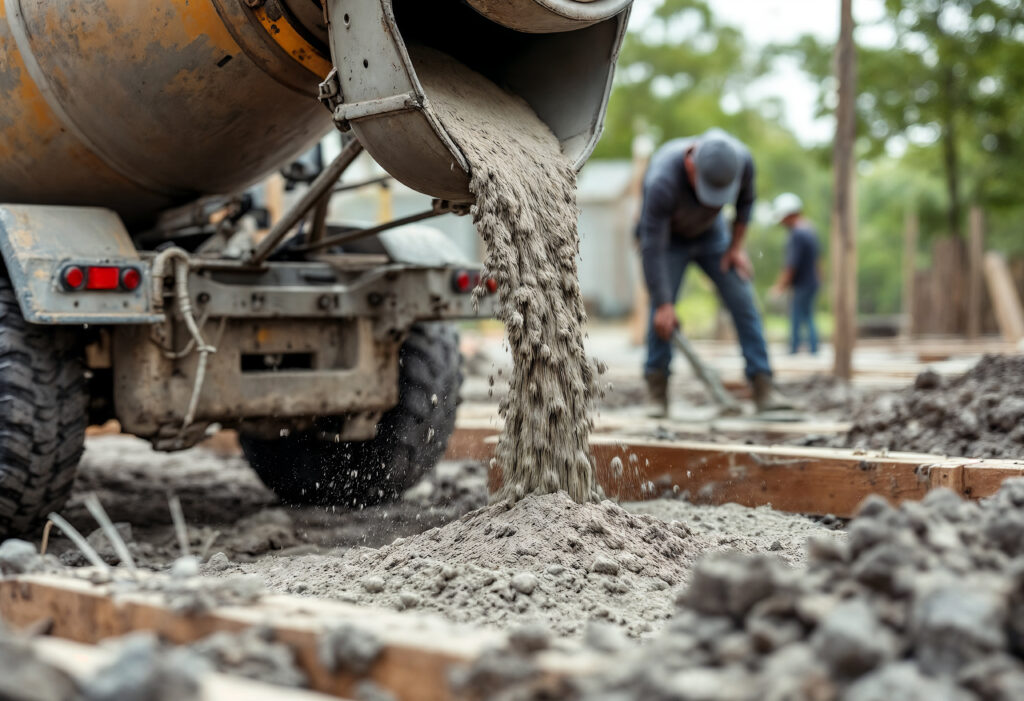
Over this, the PQC (Pavement Quality Concrete) layer is placed using fixed or slip-form pavers.
The surface is then finished, textured, and cured properly for several days before opening to traffic.
Since concrete gains strength over time, curing is a critical stage for long-term performance.
PQC, DLC, Reinforcement, and Joints
- DLC (Dry Lean Concrete): Acts as a stable base layer, prevents the pumping of fines, and improves load distribution.
- PQC (Pavement Quality Concrete): The main structural layer designed for traffic loads, braking forces, and thermal expansion.
- Reinforcement: Used where required for load transfer, crack control, and structural stability.
- Expansion, contraction, and construction joints: These joints control cracking due to temperature changes and shrinkage and are sealed to prevent water ingress.
Accurate joint layout, dowel bar placement, and proper curing directly decide the life of a concrete road.
Growing Adoption in Urban Infrastructure
Concrete roads are increasingly being adopted by PMC, PWD, Smart City projects, MIDC, and industrial townships, especially for BRT routes, bus corridors, heavy truck routes, and high-traffic urban zones.
Their ability to withstand heavy axle loads, monsoon damage, and repeated braking forces makes them a preferred long-term solution despite the higher initial construction cost.
Initial Construction Cost Comparison
One of the biggest deciding factors for government bodies and urban local authorities is the initial construction cost of roads.
At first glance, bitumen roads appear cheaper, while concrete roads require higher upfront investment.
However, the actual decision depends on material prices, traffic category, base conditions, and city priorities.
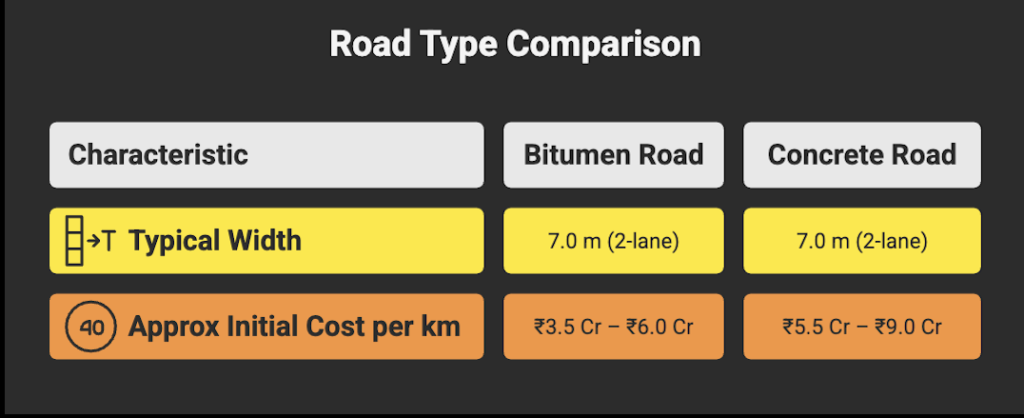
Cost per km: Bitumen vs Concrete (Indicative Indian Range)
Road Type | Typical Width | Approx Initial Cost per km |
Bitumen Road | 7.0 m (2-lane) | ₹3.5 Cr – ₹6.0 Cr |
Concrete Road | 7.0 m (2-lane) | ₹5.5 Cr – ₹9.0 Cr |
Rates vary based on DLC thickness, PQC grade, subgrade condition, and urban utility complexity.
In general:
- Bitumen roads are 25–40% cheaper initially
- Concrete roads demand higher upfront capital but offer longer service life
Material, Machinery & Labour Differences
Bitumen Roads:
- Major materials: Bitumen, aggregates, filler
- Machinery: Hot mix plant, paver, tandem & pneumatic rollers
- Labour: Higher manual involvement in patchwork and finishing
- Fuel dependency: High (bitumen production + hot mix heating)
Concrete Roads:
- Major materials: Cement, sand, aggregates, admixtures
- Machinery: Batching plant, transit mixers, slip-form or fixed pavers
- Labour: Higher skill requirement for formwork, joint cutting, surface finishing
- Power dependency: Moderate (batching + curing systems)
Concrete roads demand more precision and stricter quality control, which adds to the initial execution cost.
Budget Impact on Municipal Projects
For bodies like PMC, ZP, PWD, and Smart City authorities, the higher initial cost of concrete roads can:
- Reduce total coverage length in a single budget cycle
- Require phased execution planning
- Demand stronger tender financial capacity from contractors
However, bitumen roads allow:
- Faster approval and wider coverage within the same budget
- Quick execution before the monsoon
- Frequent upgradation flexibility
This is why most Indian cities adopt a hybrid road policy using bitumen for low to medium traffic roads and concrete for heavy-traffic, bus routes, industrial corridors, and long-life infrastructure
Maintenance Cost & Life Cycle Analysis
While initial construction cost is important, the true financial impact of a road is seen over its entire life cycle.
Maintenance frequency, repair costs, traffic disruption, and surface performance over time play a much bigger role in long-term municipal budgeting than upfront investment alone.
Annual Maintenance Needs of Bitumen Roads
Bitumen roads are flexible pavements and are more vulnerable to:
- Water ingress during the monsoon
- Rutting under heavy traffic
- Pothole formation due to repeated thermal expansion and contraction
Typical annual maintenance activities include:
- Pothole patching
- Surface renewal and crack sealing
- Shoulder repairs
- Periodic re-carpeting every 4–6 years
Because of this, bitumen roads require regular yearly maintenance, and the cost accumulates steadily over time.
In high-traffic city areas, maintenance can become a recurring and heavy financial burden for municipal bodies.
Long-Term Durability of Concrete Roads
Concrete roads are rigid pavements designed for:
- Heavy axle loads
- High braking forces
- Continuous bus, truck, and industrial traffic
If constructed correctly with proper DLC, PQC, joints, curing, and groove cutting, concrete roads can last 25 to 30 years with very minimal intervention.
Maintenance is generally limited to:
- Joint resealing after many years
- Localized surface grinding is required
- Minor crack treatment
There is no need for full surface replacement every few years, which is the biggest financial advantage of cement concrete roads.
20–30 Year Life Cycle Cost Comparison
Over a long-term horizon:
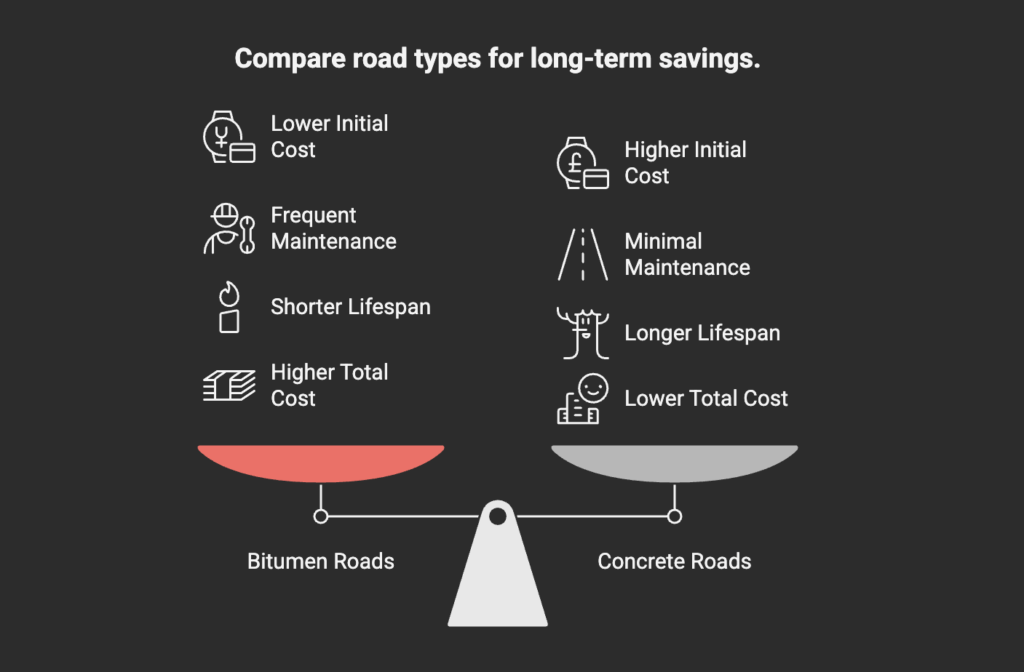
- Bitumen roads cost less initially, but demand repeated maintenance and resurfacing
- Concrete roads cost more at the start, but deliver very low running costs for decades
When total costs are calculated across 20–30 years (construction + repairs + resurfacing + traffic disruption), concrete roads often turn out to be more economical for high-traffic and industrial applications, while bitumen remains suitable for low to medium traffic zones where flexibility and fast repairs are needed.
This life cycle perspective is the reason why many urban authorities today are shifting major corridors, BRT routes, and industrial roads to concrete, while still maintaining bitumen roads for residential and low-load areas.
Performance Under Indian Conditions
Indian road infrastructure faces some of the toughest operating conditions in the world, extreme monsoons, overloaded traffic, and high surface temperatures.
The long-term success of any road depends on how well it performs under these real-world stresses, not just laboratory design values.
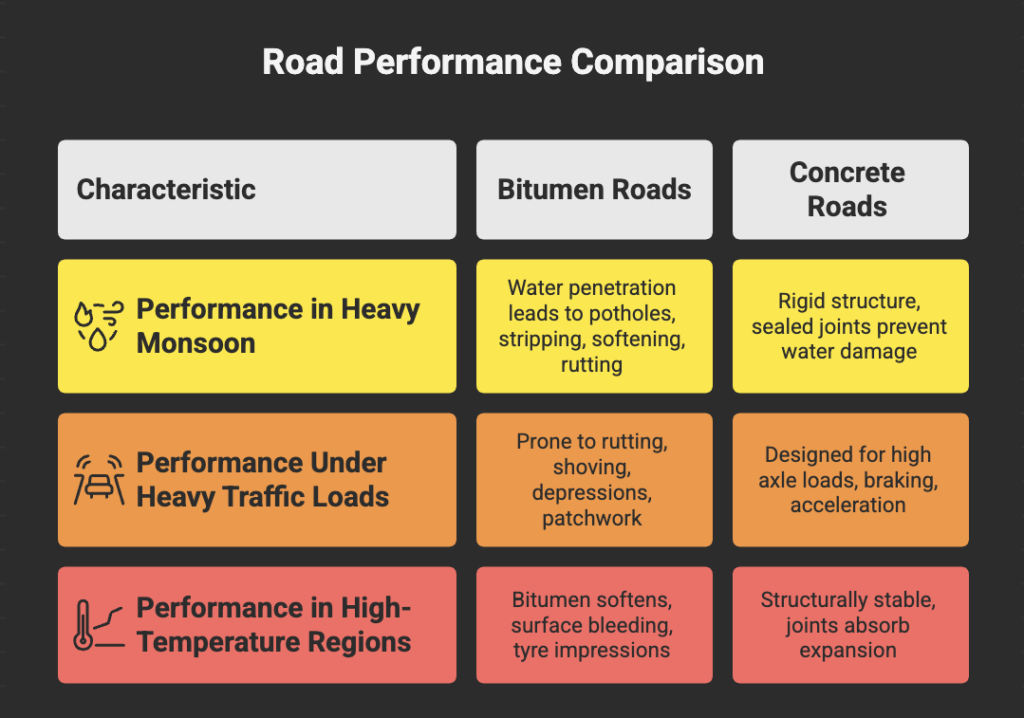
Performance in Heavy Monsoon
Bitumen Roads:
Bitumen is highly sensitive to water ingress.
During prolonged monsoon, water penetrates through cracks and weak joints, leading to:
- Pothole formation
- Stripping of aggregates
- Softening of base layers
- Rutting and surface undulations
Even well-constructed bitumen roads often show visible distress after 2–3 monsoon cycles, especially in areas with poor drainage.
Concrete Roads:
Concrete roads perform significantly better in monsoon conditions due to:
- Rigid pavement structure
- Proper joint sealing
- Low water penetration into base layers
If joints and edges are sealed correctly, concrete roads remain largely unaffected by prolonged rainfall and show minimal surface damage even after multiple monsoons.
Performance Under Heavy Traffic Loads
Bitumen Roads:
Under heavy truck, bus, and industrial traffic, bitumen roads are prone to:
- Rutting at wheel paths
- Shoving at intersections and bus stops
- Depressions at braking zones
Overloaded axle weights accelerate surface failure, and frequent patchwork becomes unavoidable.
Concrete Roads:
Concrete pavements are inherently designed for:
- High axle loads
- Constant braking and acceleration
- Bus corridors and industrial freight movement
They distribute loads over a wider area and do not deform under heavy traffic, making them ideal for BRT routes, ports, MIDC areas, and logistic corridors.
Performance in High-Temperature Regions
Bitumen Roads:
In peak summer temperatures, especially in central and western India:
- Bitumen softens
- Surface bleeding occurs
- Tyre impressions and surface waves develop
This reduces riding comfort and increases accident risk at intersections and turning zones.
Concrete Roads:
Concrete roads remain structurally stable in high temperatures.
While concrete does expand slightly, joints absorb these movements safely.
There is no surface softening, bleeding, or deformation, making concrete far more reliable in extreme heat conditions.
Construction Speed & Traffic Disruption
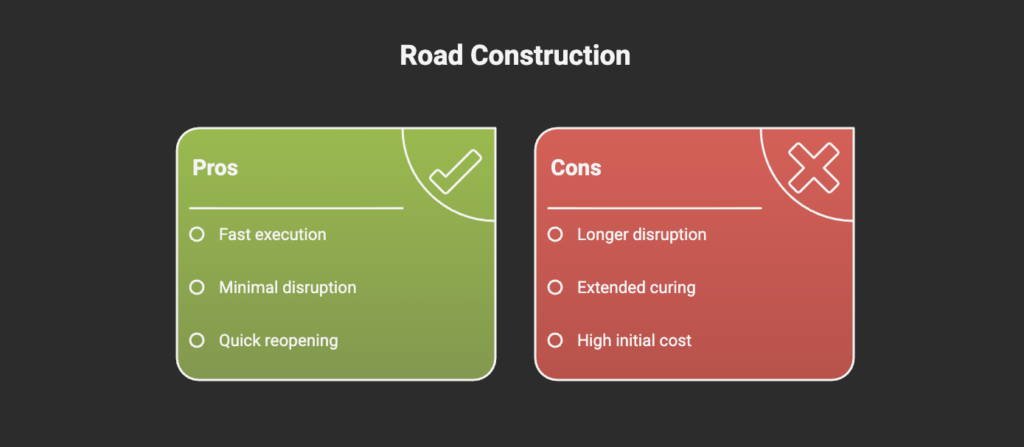
In urban India, road construction is judged not only by quality but also by how quickly the road can be executed and reopened to traffic.
Prolonged blockages directly affect public movement, business activity, and emergency services.
This is where execution speed becomes a major decision factor between bitumen and concrete roads.
Time Required for Bitumen Road Execution
Bitumen roads are known for their fast execution cycle. Once the base layers (GSB and WMM) are ready:
- DBM and BC layers can be laid quickly
- The surface becomes traffic-ready within 24 to 48 hours after laying
- No long curing period is required
This makes bitumen roads ideal for:
- Emergency repairs
- High-traffic city junctions
- Roads that cannot remain closed for long
Time Required for Concrete Road Execution
Concrete roads require a more controlled and time-bound construction process. After DLC and PQC laying:
- The surface needs proper curing for 10 to 14 days
- Groove cutting and joint sealing must be completed before opening
- Heavy vehicles are allowed only after full strength is achieved
Although slower at the execution stage, this time investment is made for long-term durability and reduced future maintenance.
Impact on Daily Traffic and Public Movement
Bitumen Roads:
- Cause short-term disruption
- Quick reopening minimizes inconvenience
- Suitable for dense commercial areas and internal city roads
Concrete Roads:
- Cause longer initial traffic diversion
- Require careful traffic planning and barricading
- Once opened, they offer decades of uninterrupted service with minimal future closures
For Indian cities, the decision often depends on a trade-off between short-term inconvenience and long-term reliability.
This is why many urban bodies prefer bitumen for quick-turnaround roads and concrete for permanent, high-load corridors.
Repair, Patching & Utility Cutting
No road remains untouched over its life cycle. Utility repairs for water lines, sewer lines, OFC cables, and drainage work are inevitable.
The real difference between bitumen and concrete roads becomes very visible during cutting, restoration, and post-repair surface performance.
Ease of Utility Cutting in Bitumen Roads
Bitumen roads are relatively easy and quick to cut and restore:
- Cutting can be done using mechanical cutters or breakers with minimal effort
- Trenching for pipelines and cables is faster
- Restoration can be completed with DBM and BC within a short time
- Traffic can often be resumed within 24 to 48 hours
This makes bitumen roads highly utility-friendly, especially in areas with frequent underground maintenance, such as:
- Old city zones
- Water distribution networks
- Sewer rehabilitation corridors
However, repeated cutting and patching weaken the layered structure over time.
Restoration Challenges in Concrete Roads
Concrete roads are structurally strong but difficult to restore after cutting:
- Cutting requires heavy breakers or wire-cutting machines
- Reinforcement and dowel bars complicate excavation
- Proper edge preparation and joint matching are critical
- New concrete needs curing time before reopening
If restoration is not done with proper DLC, PQC, dowel alignment, and curing, it can lead to:
- Differential settlement
- Edge breaking
- Visible patch lines
- Long-term riding discomfort
This is why concrete road cutting must be planned carefully and executed by skilled agencies only.
Long-Term Surface Quality After Repairs
Bitumen Roads:
- Patched areas often show:
- Surface undulations
- Visible joint lines
- Early rutting
- Over repeated repairs, the overall riding quality reduces significantly
Concrete Roads:
- If restored properly:
- Surface remains stable
- No rutting or depression
- Structural integrity is retained
- But poor restoration leads to:
- Cracks at patch edges
- Water seepage below the slab
- Long-term damage around utility zones
In summary, bitumen roads offer ease of repair but lose quality over time, while concrete roads demand skilled restoration but retain long-term performance when done correctly.
Environmental Impact & Sustainability
With growing focus on climate change, carbon emissions, and sustainable infrastructure, environmental impact has become a major factor in road technology selection.
Both bitumen and concrete roads affect the environment in different ways, some at the construction stage and others over the long term.
Carbon Footprint of Bitumen Roads
Bitumen is a petroleum-based product, and its production, heating, and mixing are energy-intensive processes.
The environmental impact of bitumen roads includes:
- High fuel consumption in hot mix plants
- Emissions during heating, transport, and laying
- Dependency on crude oil-based materials
- Repeated resurfacing every few years which adds to cumulative emissions
Although bitumen roads require lower cement usage, their frequent maintenance cycles significantly increase their long-term carbon footprint.
Cement Production vs Long-Term Environmental Benefit
Cement manufacturing is known to be a high CO₂-emitting process, which increases the initial environmental load of concrete roads.
However, this impact must be compared with the life-cycle performance of concrete pavements:
- Concrete roads last 25–30 years with minimal resurfacing
- No repeated hot mix production is required
- Reduced fuel consumption for maintenance
- A stable surface reduces vehicle fuel wastage due to undulations
Over the long term, the total environmental impact of a concrete road often becomes lower than that of a frequently resurfaced bitumen road.
Recyclability and Reuse Considerations
Bitumen Roads:
- Old asphalt can be milled and reused as RAP (Reclaimed Asphalt Pavement)
- Recycling reduces raw material demand
- Quality depends on a proper mix design and binder rejuvenation
Concrete Roads:
- Old concrete can be crushed and reused as:
- Road sub-base material
- Aggregate for non-structural applications
- No hazardous residue
- Long service life reduces demolition frequency
From a sustainability perspective, both road types are recyclable, but concrete roads gain an edge due to their longer service life, reduced maintenance emissions, and stable performance.
Skid Resistance, Safety & Night Visibility
Road safety is not decided only by speed limits and traffic rules; it is strongly influenced by surface texture, braking grip, water behavior during rain, and night-time visibility.
The difference between bitumen and concrete roads becomes very noticeable in these safety-related aspects.
Driving Comfort and Braking Grip
Bitumen Roads:
Provide a smooth and silent riding surface initially, which improves driving comfort. However, over time:
- Surface polish reduces skid resistance
- Braking distance increases at high speeds
- Rutting in wheel paths affects vehicle stability
Concrete Roads:
Concrete roads, especially with proper groove cutting (texturing), offer:
- Consistent skid resistance
- Stable braking grip even at higher speeds
- No surface deformation at bus stops, signals, and junctions
This makes concrete roads safer in heavy traffic and high-braking zones.
Performance During Rain
Bitumen Roads:
During monsoon:
- Water tends to form a thin film on the surface
- Polished or bleeding surfaces can become slippery
- Potholes suddenly appear, increasing accident risk
Concrete Roads:
With proper slope, joint sealing, and groove cutting:
- Water drains quickly
- Surface remains stable
- Skidding risk is significantly lower
This gives concrete roads a clear safety advantage in rainy conditions.
Visibility and Lane Marking Durability
Bitumen Roads:
- Lane markings fade faster due to frequent resurfacing and heat
- Night visibility reduces as the surface darkens over time
Concrete Roads:
- Naturally lighter surface reflects more light
- Lane markings last longer
- Better night visibility with lower headlight glare
This improves driver confidence, reaction time, and overall road safety, especially in urban and highway night driving.
Load Carrying Capacity & Industrial Use
One of the most important differences between bitumen and concrete roads lies in their ability to handle continuous heavy axle loads, braking stress, and concentrated traffic movement.
This factor becomes critical in bus corridors, industrial zones, and freight-heavy routes.
Suitability for Buses, BRT, Trucks & Cargo Vehicles
Bitumen Roads:
Bitumen roads perform reasonably well under:
- Light commercial vehicles
- Passenger buses with moderate frequency
- Mixed city traffic
However, under constant heavy loading:
- Wheel path rutting develops quickly
- Shoving occurs at bus stops and intersections
- Surface deformation increases braking distance
This leads to higher maintenance at:
- BRT lanes
- Bus bays
- Signal junctions
- Truck turning zones
Concrete Roads:
Concrete pavements are specifically designed to handle:
- Continuous heavy bus movement
- High axle truck loads
- Sharp braking and turning forces
They do not rut, deform, or shove under load. This makes them ideal for:
- BRT corridors
- Industrial truck routes
- Port connectivity roads
- Container movement lanes
Industrial Zones, Ports & Logistics Hubs
In areas such as:
- MIDC industrial estates
- Ports and cargo terminals
- Warehouse clusters
- Logistics parks
Concrete roads offer:
- Long slab life under heavy loads
- Stable surface for forklifts and container movers
- Reduced maintenance shutdowns
- Better operational uptime
Bitumen roads are still used in internal lanes and low-load yards, but main haul roads in industrial environments are increasingly being constructed in concrete for reliability and cost efficiency.
Which One Is Better for Different Authorities?
In India, the choice between bitumen and concrete roads is rarely uniform across all regions and authorities.
Each governing body, whether urban, rural, highway, or industrial, has different technical needs, budget constraints, traffic patterns, and maintenance capacities.
The right road type depends on matching the technology to the use case.
PMC City Roads
For city authorities like PMC, the challenge is managing:
- High traffic density
- Frequent utility cutting
- Limited work windows
- Public inconvenience during closures
Bitumen roads are preferred for:
- Internal city roads
- Commercial streets
- Areas with frequent pipeline, drainage, and OFC works
Concrete roads are now increasingly used for:
- BRT routes
- Major arterial roads
- High-traffic junctions
- Bus corridors and signal-heavy zones
PMC typically adopts a hybrid model of bitumen for flexibility and concrete for permanence.
Zilla Parishad (ZP) Rural Roads
ZP roads focus on:
- Rural connectivity
- Budget efficiency
- Faster execution
- Moderate traffic loads
Here, bitumen roads are generally the better choice because:
- Lower initial cost allows wider coverage
- Faster construction suits seasonal work windows
- Easy repair suits remote locations
Concrete roads are selectively used in:
- Market areas
- School zones
- Village junctions
- Bus-heavy rural corridors
PWD Highways & State Roads
PWD roads carry:
- High-speed traffic
- Long-distance freight
- Heavy trucks and buses
For these roads:
- Bitumen is still dominant for highways due to riding comfort, easier widening, and staged upgrades
- Concrete is now being increasingly used for:
- Expressways
- Flyovers
- Dedicated freight corridors
- Toll highways with heavy axle loads
PWD decisions are now strongly driven by life-cycle cost rather than just initial cost.
Industrial MIDC & Private Layouts
In MIDC areas, ports, logistics parks, and industrial layouts, the priorities are:
- Load-bearing capacity
- Zero rutting
- Minimal shutdowns
- Long service life
Here, concrete roads are clearly the superior choice because they:
- Handle continuous truck and container loads
- Resist oil spills and heavy braking
- Maintain surface integrity for decades
- Reduce long-term maintenance costs
Bitumen is often limited to:
- Parking areas
- Low-load internal lanes
- Temporary diversion roads
Common Myths About Concrete and Bitumen Roads
Over the years, several assumptions have developed around concrete and bitumen roads.
Many of these beliefs come from poor execution in the past rather than from the actual performance of the road technology itself.
Understanding the truth behind these myths helps authorities and planners make decisions based on engineering facts rather than perception.
“Concrete Roads Crack Easily”
This is one of the most common misconceptions.
Concrete does not crack randomly when designed and constructed correctly. Cracking usually happens due to:
- Improper joint spacing
- Poor curing
- Incorrect mix design
- Bad compaction
- Thermal stress without an expansion provision
When correct DLC base, proper PQC grade, accurate joint cutting, dowel placement, and controlled curing are followed, concrete roads perform for decades without structural cracking.
Visible cracks are usually the result of execution defects, not material failure.
“Bitumen Roads Are Always Cheaper”
Bitumen roads appear cheaper only in terms of initial construction cost.
When viewed over a full life cycle:
- Frequent resurfacing
- Annual maintenance
- Pothole repairs
- Traffic disruption during patching
…all add recurring expenses. Over 20–30 years, these repeated costs often make bitumen roads more expensive than concrete in high-traffic zones.
So bitumen is cheaper upfront, but not always cheaper in the long run.
“Concrete Roads Take Too Long to Build”
Concrete roads do take more time initially due to:
- DLC and PQC placing
- Groove cutting and joint sealing
- Mandatory curing period
However, this time investment is made once for a 25–30-year service life.
Bitumen roads may open quickly, but frequent closures for repairs over the years cause far more cumulative public inconvenience.
So when viewed over the long term, concrete roads actually result in less total downtime.
Real Execution Challenges on the Ground
While design standards and tender documents define how roads should be built, actual execution on site is shaped by real-world constraints that are often far more complex than drawings suggest.
These ground-level challenges largely decide both the quality and the timeline of a road project.
Drainage Coordination
Improper or delayed drainage work is one of the biggest reasons for road failure in India. In many projects:
- Stormwater drains and road works are not synchronized
- Outfalls are missing or incomplete
- Water stagnates below the pavement layers
Both bitumen and concrete roads suffer badly if drainage is weak.
Water entering the subgrade leads to:
- Base softening in bitumen roads
- Pumping and joint damage in concrete roads
Without proper drainage planning, even the best road design fails prematurely.
Utility Shifting
Urban roads always face conflicts with:
- Water pipelines
- Sewer lines
- Gas lines
- OFC cables
- Electric ducts
Delays in utility shifting cause:
- Frequent work stoppages
- Sudden trench cutting after road completion
- Surface damage due to repeated restorations
Concrete roads are especially sensitive to unplanned cutting, making pre-construction utility coordination absolutely critical.
Traffic Management
Maintaining traffic flow during construction is one of the toughest execution challenges.
Issues commonly faced include:
- Narrow work zones
- Peak-hour congestion
- Pedestrian safety risks
- Public resistance to long closures
Improper traffic handling leads to:
- Accidents
- Public complaints
- Political and administrative pressure
- Forced execution shortcuts that affect quality
Quality Control Issues
Quality control often suffers due to:
- Poor compaction of GSB and WMM
- Incorrect concrete mix proportions
- Inadequate curing
- Improper joint cutting
- Uncontrolled groove cutting
Even small lapses at these stages lead to:
- Early surface failure
- Cracking
- Rutting
- Reduced riding quality
This is why strict on-site supervision, testing, and documented QA/QC processes are essential for both bitumen and concrete road projects.
How Professional Execution Makes the Difference
No matter whether a road is built in bitumen or concrete, the final performance always depends on the execution quality on the ground.
The same design can either deliver 25 years of trouble-free service or start failing within 2–3 years purely based on how professionally it is executed.
Importance of Base Preparation
The foundation of any good road is its base. Proper:
- Subgrade compaction
- GSB grading and density
- WMM thickness control
…decides how well the road carries a load over time. Poor base preparation leads to:
- Rutting in bitumen roads
- Slab settlement in concrete roads
- Cracks, depressions, and edge failures
Once the base is weak, no surface layer can compensate for it.
Concrete Temperature Control
For concrete roads, temperature control during pouring is critical. High concrete temperature causes:
- Rapid moisture loss
- Plastic shrinkage cracks
- Surface weakening
Professional execution includes:
- Ice or chilled water in hot weather
- Controlled placing time
- Immediate curing using wet hessian, curing compounds, or sprinklers
This ensures proper strength gain and long-term durability.
Compaction and Finishing Accuracy
For both road types:
- Bitumen roads need exact rolling patterns and density control
- Concrete roads need correct surface finishing, texturing, and groove cutting
Improper compaction leads to:
- Early rutting in bitumen
- Surface scaling in concrete
- Reduced skid resistance and riding comfort
Joint Treatment and Curing
In concrete roads, joints are the life of the pavement. Incorrect:
- Joint spacing
- Dowel alignment
- Joint sealant application
…leads to uncontrolled cracking and water ingress.
Along with this, curing is non-negotiable.
Without proper curing, even the best concrete mix will fail prematurely.
Conclusion: The Right Road for the Right Application
There is no single road technology that is perfect for every situation in India.
Bitumen and concrete roads both have their own strengths, and the right choice depends on traffic load, execution conditions, budget availability, utility interference, and long-term maintenance strategy.
For low to medium traffic roads, internal city streets, and rural connectivity, bitumen remains a practical and cost-effective solution.
For high-traffic corridors, bus routes, industrial zones, and freight-heavy roads, concrete clearly delivers superior durability, safety, and life-cycle value.
For Indian cities to grow in a sustainable and economically efficient manner,
a hybrid road planning approach is the most sensible path forward, using bitumen where flexibility and speed are required, and concrete where permanence and long-term reliability are essential.
When road selection is aligned with actual on-ground usage rather than just initial cost, urban infrastructure becomes stronger, safer, and far more sustainable over decades.